
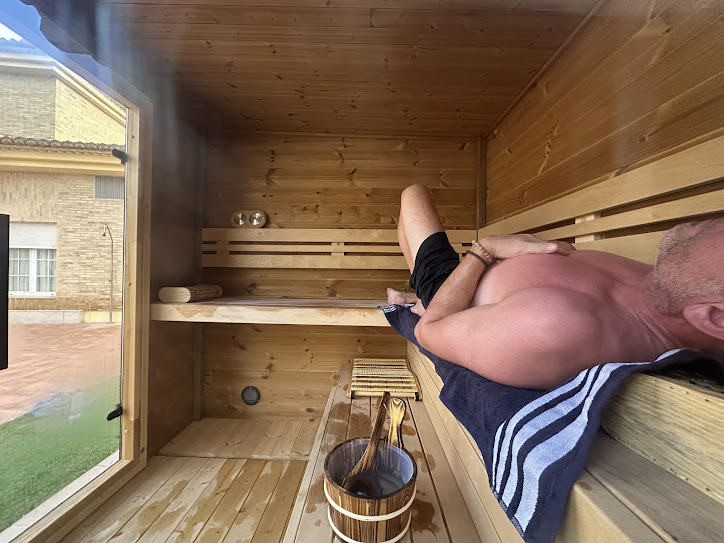

In Iceland, everyone is talking about Gusa. It’s the latest wellness ritual making its way through the country — a sensory sauna experience where heat, cold, aromas, breath, and music are woven together into a shared journey. In many ways, it feels like a modern expression of ancient sweat rituals — familiar, yet newly reimagined.
What is both funny and wonderful is how we Icelanders tend to move in herds when something meaningful appears on the map. When something catches our attention, we show up — curious, open, and ready to experience it together. And Gusa is one of those moments.
Before it became a trend, one of my husband’s and my favourite rituals has been using the sauna to ground ourselves — body and mind. For me, it feels like cleansing not only my skin, but my whole being. As soon as I step into the warm space, I can feel my entire system soften, quiet, and exhale.
I usually do a few rounds of 10–15 minutes, followed by a gentle step into cold water — sometimes a shower at around 15°C, or a short dip in my pool, which now sits at about 10°C.
As a middle-aged woman moving through hormonal changes, I’ve become more sensitive to how my body reacts. I can feel the difference between what is invigorating and what becomes too much. Extreme cold can spike cortisol — the body’s stress hormone — which, for me, feels overstimulating rather than balancing. So I’ve learned to listen: moderate contrast works best. Gentle transitions, not shocks.
The Ancient Wisdom of Heat — and Its Benefits
Sauna baths have been used for centuries — in Nordic, Baltic, and many Indigenous traditions — as a way to cleanse, restore, and reconnect. When we sit in the warmth, the body naturally begins to open, soften, and release. We sweat, our circulation improves, and the nervous system settles.
In addition to these well-established benefits, recent research suggests that regular sauna bathing may support cardiovascular health, alleviate muscular and joint tension, and aid the body’s natural detoxification processes through increased sweating. Heat may also influence blood pressure, improve vascular function, and gently activate the body’s repair responses — though these effects vary from person to person and tend to be most noticeable with consistent practice.
Beyond the physical, there’s something deeply ritualistic about the heat. It softens what is rigid — not only in the muscles, but in the heart and mind. After 10 minutes in the sauna, my breath deepens, my thoughts slow, and I can feel myself returning to presence.
Heat & Hormones — A Gentle, Balanced Perspective
While the sauna experience is personal for each of us, some studies and observations suggest that heat may influence certain hormonal pathways in ways that feel supportive. These effects differ between individuals, and many changes — such as rises in metabolic or growth-related hormones — are temporary, which is why regular sauna practice often feels more beneficial than occasional visits.
For both men and women, heat exposure may help:
- Encourage a temporary rise in certain metabolic and growth-related hormones
- Reduce stress levels, supporting overall hormonal balance
- Calm the nervous system and soften tension
- Improve circulation, mood, and general relaxation
Some women — especially during perimenopause and menopause — report additional benefits such as reduced intensity of hot flashes, deeper sleep, and a stabilising, grounding effect. Many people, across ages and genders, describe feeling clearer, calmer, and more energised after heat exposure.
Still, responses vary. There is no single “right” way to use heat. The most important guidance is to listen closely to your own body and mind — they will always show you what feels supportive and what does not.
The Magic of Cold
Cold has its own medicine — clarity, alertness, awakening. A cool shower or plunge after heat tightens the tissues, stimulates circulation, and wakes up the whole system.
But cold is not a one-size-fits-all experience.
We each have to explore how our body responds. I once took part in a multi-week Wim Hof cold-training course that concluded with an ice bath. Throughout the entire program, my body never warmed up afterward — I spent the whole night freezing. That taught me that extreme cold simply doesn’t support my system.
However, when I follow cold with heat — sauna or a warm bath — it feels completely different. That rhythm suits me well.
Some people, especially men, may feel energised with short, intense cold exposure. Others, particularly women during hormonal transitions, may be more sensitive to a bad cold as a stressor. Gentle, shorter cold can feel balancing, while extremes may cause stress responses.
This doesn’t mean cold is “bad” — it simply means each body has its own wisdom. A few breaths in cool water, a slow shower, or a brief dip can offer renewal without overwhelming the nervous system.
Heat and Cold — The Dance of Balance
Alternating heat and cold mirrors nature’s rhythm — expansion and contraction, fire and ice, action and rest. Together, they create a circulatory dance that may support:
- Detoxification through sweating and flushing
- Immune function
- Nervous system regulation
- Hormonal balance
- Mental clarity and emotional calm
Spiritually, the sauna becomes a portal of renewal — a place to release what no longer serves, to return to simplicity, breath, and being.

A Gentle Note on Safety & Self-Care
While sauna and cold exposure can be deeply nourishing for many people, they are also powerful stressors on the body. Individual responses vary, and what feels supportive for one person may feel overwhelming for another.
If you have cardiovascular conditions, are pregnant, experiencing acute illness, or managing other health concerns, it’s wise to approach heat and cold with extra care and to consult a healthcare professional if needed. Even without specific conditions, listening closely to your body’s signals — dizziness, excessive fatigue, or discomfort — is essential.
This ritual is not about endurance or pushing limits. It’s about presence, awareness, and respect for your own system. Gentle transitions, hydration, and rest are part of the practice. When in doubt, less is often more.
A Ritual for Modern Times
For me, sauna time isn’t only a physical practice. It’s a sacred pause — a moment to return to myself. I like to enter with intention:
What am I ready to release? What am I ready to invite in?
And I leave with gratitude — for the body that carries me, for the warmth that holds me, and for the cool water that reminds me to wake up to life again and again.
Further Reading & Supporting Resources
Clinical Effects of Sauna Bathing
Hussain, J. & Cohen, M. (2018)
Clinical effects of regular dry sauna bathing: A systematic review.
Evidence-Based Complementary and Alternative Medicine.
This review explores how regular sauna bathing may support cardiovascular health, circulation, stress regulation, and overall well-being, while emphasising that responses vary between individuals and benefits are most noticeable with consistent practice.
https://onlinelibrary.wiley.com/doi/10.1155/2018/1857413
Endocrine Effects of Sauna Bathing
Huhtaniemi, I. T. & Laukkanen, J. A. (2020)
Endocrine effects of sauna bath.
This paper discusses how heat exposure may temporarily influence stress hormones, metabolic hormones, and growth-related pathways, highlighting that these effects are generally short-lived and differ by sex, age, and individual sensitivity.
https://www.sciencedirect.com/science/article/abs/pii/S2451965019301048
Cold Exposure & Autonomic Function
Jdidi, H. et al. (2024)
The effects of cold exposure on cardiovascular and autonomic control responses: A systematic review.
This review examines how cold exposure affects the autonomic nervous system, explaining why some people feel energised while others experience stress responses — supporting the idea that cold tolerance and benefit are highly individual.
https://www.sciencedirect.com/science/article/abs/pii/S0306456524000755
 Holistic Wellbeings
Leave a Reply