
The idea for this article came from a recent conversation with someone I’m accompanying on his inner journey. We were discussing the importance of listening inward — of noticing how we feel, what we truly need, and how we can support ourselves from a place of honesty and presence.
At one point, he asked, “Could you help me understand the balance between feeling and logic — what this process really requires?” And then said, “Maybe that could be a topic for your next article?”
Yes, thank you, dear friend — that’s a beautiful idea. So, let’s explore what it’s about.
The Wisdom of Feeling
In our culture, logic often takes the lead. We’re taught to analyze, plan, and make sense of everything through reason. Logic helps us organize the world, make choices, and feel safe in what we understand.
Yet in inner work — and in the space of expanded awareness — there comes a moment when logic must gently step aside. Not disappear, but make room for something deeper: feeling.
Feeling is the language of the body.
When we slow down and listen inwardly, we begin to notice sensations — warmth, tension, ease, or contraction. These are messages from within. They tell us when something feels aligned or when something is out of balance.
Learning to feel is not about becoming emotional; it’s about becoming present.
When we give space to what we feel, we access a quiet knowing that doesn’t need to be explained.
Through practice, we begin to trust the natural intelligence of the body — that soft inner voice that’s always been there, just waiting to be heard. Over time, we recognize when we need rest, when we’re closing our hearts, or when something feels deeply right, even if it defies logic.
I often notice this in myself: when I have to make a decision and can’t find clarity in lists of pros and cons, I pause and turn inward. What does my gut say? How does my heart feel? We’ve used that language for generations because the body knows long before the mind catches up.
The Role of Logic
Logic also has an essential place in this journey. It brings clarity and structure. It helps us prepare, reflect, and integrate what we experience.
But logic alone can’t lead us through transformation. It seeks control and certainty, while growth often arises where control softens and mystery is allowed.
The path of healing invites a dance between these two — feeling and logic — where each informs and balances the other. Logic offers grounding; feeling brings depth. Together, they create wholeness.
The Ego — Our Companion and Our Mirror
And then there is the ego — the third presence in this dance.
The ego is the part of us that says, “I am this person.” It gives us identity, helps us navigate daily life, and keeps us safe. We need it.
But the ego can also grow rigid. It clings to its roles, beliefs, and stories — trying to protect us from discomfort or vulnerability. In doing so, it can sometimes stand between us and our deeper truth.
Feeling and logic both interact closely with the ego. Logic often serves it — trying to explain, justify, or control — while feeling can soften it. When we allow emotions and sensations to surface without judgment, the ego begins to relax. It realizes it doesn’t have to defend us all the time.
I’ve experienced it myself, and seen this many times in inner work: someone begins to feel sadness or fear arise, and their first instinct is to push it away — “I shouldn’t feel this.” But when they pause, breathe, and let the emotion be felt, something shifts. The ego loosens its grip. The tears or trembling that follow aren’t weakness — they’re freedom. It’s in that surrender that the heart opens, and the person often says afterward, “I didn’t realize how much I was holding on.”
In deep inner or medicine work, we often experience moments of ego softening — where its tight grip loosens and we glimpse the larger self beyond it. This isn’t about losing individuality, but remembering that we are more than our stories.
As the ego becomes understood and integrated, it transforms from a guard into a guide — helping us bring insight and authenticity back into everyday life.
The Integration of All Parts
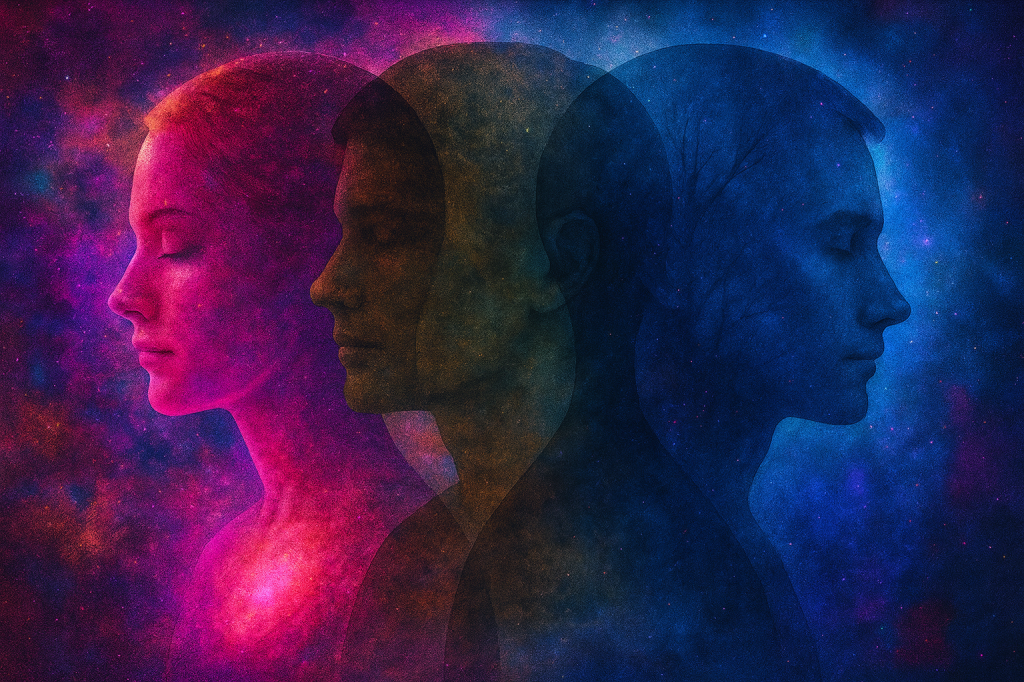
The balance of feeling, logic, and ego is not a struggle between parts of ourselves — it’s an inner dialogue.
Logic offers clarity.
The ego provides structure.
Feeling brings truth.
When they learn to work together, we begin to live with greater harmony. Decisions become less about control and more about alignment. We act not only from what we think is right, but from what we feel is true.
In Practice — A Simple Way to Listen Inward
Take a quiet moment, place one hand on your chest and one on your belly.
Breathe slowly — in through the nose, out through the mouth.
Ask yourself:
What am I feeling right now?
What does this part of me need?
Don’t analyze — just listen. Let the body speak before the mind answers.
This is how we begin to bridge the wisdom of feeling, the guidance of logic, and the gentleness of the ego.
In the sessions and programs I guide, this balance becomes a living experience. When logic softens, the ego relaxes, and the body’s wisdom begins to speak — we meet ourselves more fully.
This is the essence of inner work: learning to listen, to trust, and to walk through life with more presence, curiosity, and grace.
And perhaps as you finish reading this, you can pause for a moment and ask yourself:
Which voice is leading me right now — my logic, my feeling, or my ego?
And what might happen if they all learned to sit together in peace?
Suggested Readings & Resources
- No Bad Parts — Dr. Richard C. Schwartz
- The Body Keeps the Score — Dr. Bessel van der Kolk
Talks to Explore:
If you prefer listening to these ideas in conversation, here are a few talks that echo the same essence — learning to feel, understand, and integrate the parts within us:
Gabor Maté — The Power of Authenticity and Connection: In this talk, Gabor Maté explores how suppression of emotion disconnects us from our authentic self, and how healing begins when we learn to feel what we’ve long avoided. https://www.youtube.com/watch?v=vItHqEHC_7E
Your Personality Is a Defensive Cover: A short, moving talk about how our stories and roles shape identity — and how reconnection with the true self is the path to wholeness.
https://www.youtube.com/watch?v=joCOWaaTj4A
Eckhart Tolle — The Challenge of Presence in the Face of the Ego: A simple and direct explanation of how the ego resists the present and how awareness loosens its grip.
https://www.youtube.com/watch?v=rG4nCkRYCcw
Richard Schwartz (IFS) — Dr. Richard Schwartz explains Internal Family Systems (IFS): A short introduction to Internal Family Systems and understanding our inner parts.
https://www.youtube.com/watch?v=Jr06qzBYhS8
 Holistic Wellbeings
Leave a Reply